
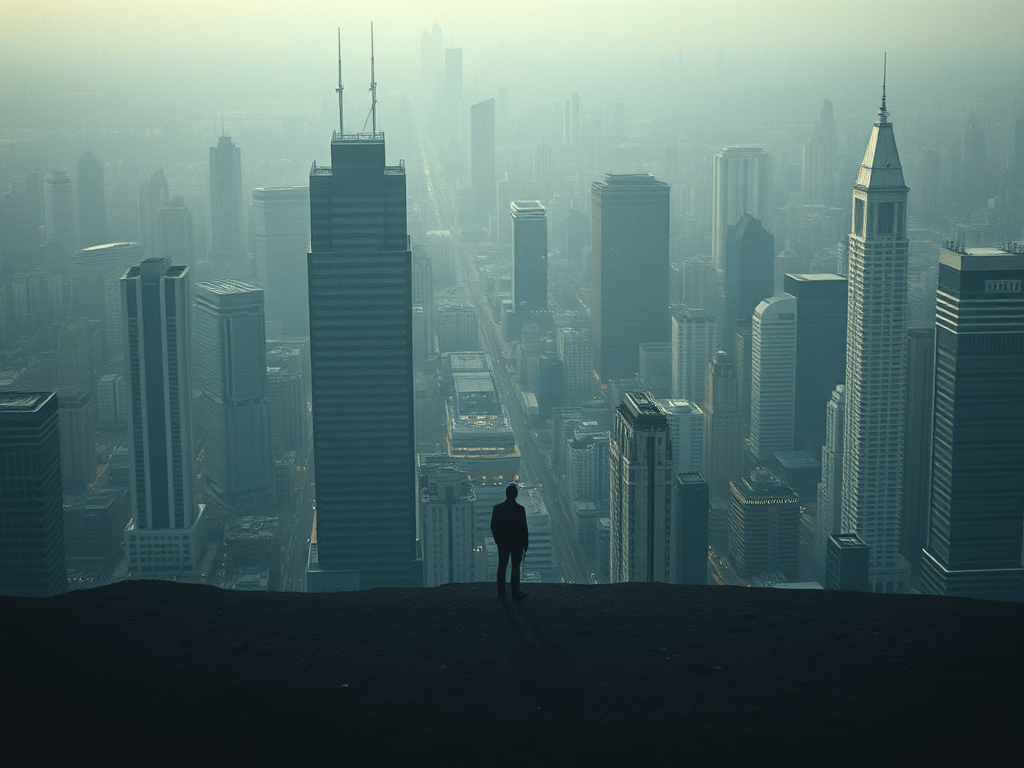
🔱 A World Built on the Weight of the Autonomous Self
We are living in a time when the self has become the last sacred thing — and it is collapsing under the weight of its own divinity.
Human societies today are wrestling with a profound crisis. It is not merely political turmoil or economic instability, nor is it reducible to culture wars or technological disruption. These are surface tremors. The deeper fault line runs through the modern understanding of authority, meaning, and identity. What we are facing is not a crisis of mood or politics, but a crisis of structure — a transformation in the very architecture of the self.
For most of human history, the self was situated within larger orders it did not create. People understood themselves as part of a world shaped by divine reality, moral tradition, communal belonging, and inherited narratives. These structures did not eliminate individuality; they located it. They offered a vertical axis — a sense of height, depth, and orientation — that anchored human life in something more enduring than personal preference.
The vertical is not merely religious. It is any source of meaning, truth, or authority that stands above the self and is not created by it — the moral horizon, the inherited story, the transcendent reference point that gives human life shape.
In our time, that vertical axis has flattened. What remains is a horizontal world of individual preference, personal choice, and self‑constructed identity. As traditional structures weaken and individuals are left to construct meaning from within, the self increasingly stands alone as the final arbiter of truth, identity, and purpose.
This crisis is not Western or Eastern, religious or secular, rich or poor. It is global — a structural feature of modernity itself.
And like a building whose foundations have been removed, the modern self stands tall but unstable: impressive in its autonomy, yet trembling under its own weight.
At the heart of this transformation lies a new cultural creed — rarely stated outright, yet absorbed everywhere:
“I am my own authority.
I am my own project.
I am my own truth.
I am my own savior.”
This creed promises freedom. But it also shifts onto the individual a burden once carried by entire civilizations. The self must now generate its own meaning, justify its own existence, and secure its own worth without the support of transcendence, community, or tradition. It must be both creator and creature, judge and defendant, physician and patient. The self has been enthroned — and in being enthroned, it has been condemned to carry a weight it cannot sustain.
🧭 The Rise of the Autonomous Self: Losing the Vertical, Drifting in the Horizontal
The rise of the autonomous self did not appear overnight. It is the long outcome of several historical shifts:
- the Enlightenment’s elevation of individual reason,
- the Romantic turn toward expressive identity,
- the modern suspicion of inherited authority,
- and the late‑modern collapse of communal and transcendent structures.
Each step loosened the self from the vertical, leaving it increasingly responsible for constructing its own foundations.
Historically, the self was nested within four larger orders:
- A transcendent order, which provided a moral horizon beyond personal preference.
- A moral order, which shaped character and constrained desire.
- A communal order, which gave identity through belonging.
- A narrative order, which offered a story larger than the individual life.
These orders gave the self depth and direction. Their erosion leaves the individual floating, unanchored, and responsible for constructing meaning from scratch.
A young adult with infinite options feels strangely trapped by them.
The modern promise of limitless choice — “you can be anything” — sounds liberating. But limitless choice is not freedom. It is paralysis, anxiety, and rootlessness. Without a larger order to situate the self, identity becomes a project of endless reinvention, and reinvention becomes a form of quiet despair. The self becomes a perpetual construction site, never finished, never secure, never at rest.
🧩 The Collapse of Shared Legitimacy: A Society Without a Shared “We”
As the self becomes the final authority, the shared world that once held people together begins to fracture.
🏛️ The Erosion of Traditional Authority: Institutions Without Foundations
As the self rises, traditional sources of authority lose their binding force. Institutions that once commanded trust — whether religious, civic, familial, or cultural — now struggle to justify themselves. Their claims feel arbitrary because they no longer rest on a shared foundation. What once seemed self‑evident now appears negotiable. Authority becomes something to be chosen, not something to which one belongs.
🌐 The Fragmentation of the “We”: Tribes, Algorithms, and the Shattered Commons
A society cannot function without a shared “we.” But modern conditions dissolve the “we” into tribes, micro‑communities, and algorithmic enclaves. People inhabit different moral universes, shaped by different narratives and different authorities. Without a shared world, disagreement becomes incomprehension, and politics becomes existential.
A man who can broadcast his life to thousands feels unseen by the people closest to him.
Politics becomes not a negotiation of interests, but a clash of sacred selves — each demanding recognition, each unable to yield, each treating compromise as betrayal. When the self is ultimate, politics becomes ungovernable. Every disagreement becomes a referendum on identity. Every conflict becomes a crisis of legitimacy.
🎭 The Shift From Truth to Emotion and Consent: When Feeling Replaces Truth
When transcendence fades, legitimacy becomes a matter of procedure or sentiment. Decisions are justified because they were voted on, or because they feel right to a particular group. But procedural legitimacy cannot replace moral legitimacy. A society cannot be held together by process alone. When truth becomes subjective and obligation becomes optional, the bonds that sustain shared life begin to fray.
⚖️ The Exhaustion of Self‑Salvation: The Impossible Burden of Being One’s Own God
If the self is the final authority, it must also become its own source of meaning, identity, and worth. This is an impossible task.
💔 The Emotional Burden of Self‑Creation: The Weight of Inventing Yourself
When the self becomes the center of meaning, it must also become the site of salvation. People are told to heal themselves, define themselves, and validate themselves. But the self is limited, conflicted, and vulnerable. It cannot absolve its own guilt or guarantee its own worth. It cannot carry the weight of being its own god.
A woman who can reinvent herself endlessly no longer knows which version is real.
The emotional consequences are visible everywhere:
- rising anxiety and depression
- pervasive loneliness
- identity instability
- burnout and exhaustion
- polarization and rage
- a sense of emptiness beneath achievement
These are not isolated pathologies. They are the predictable outcome of a world that has placed too much weight on the individual.
🎥 Identity as Performance: The Self on Stage, Always Being Watched
When identity is self‑constructed rather than received, it becomes performative. The self must continually project, curate, and defend its chosen identity. This performance requires constant external affirmation, making identity fragile and easily threatened. The self becomes both actor and audience, endlessly watching itself.
📱 Technology as the Digital Mirror of the Fragile Self
Technology functions as a mirror that reflects the self back to itself — but in a distorted form. It magnifies desire, accelerates envy, and fragments attention. It offers connection without community, expression without formation, and visibility without belonging. In this environment, the self becomes hyper‑aware of itself yet increasingly unsure of itself. The digital world promises empowerment, but often delivers a deeper fragility. It invites the self to be endlessly curated and constantly displayed, while quietly eroding the interior life that once grounded identity in something more stable than public perception.
🪞 The Failure of Self‑Sufficiency: The Self Cannot Give Itself What It Most Needs
The promises of self‑care, self‑expression, and self‑optimization ring hollow when confronted with the deeper needs of the human heart. The self cannot give itself what it most longs for: unconditional worth, enduring identity, and a sense of belonging that transcends circumstance. The self cannot stand outside itself to bestow the worth it craves. Self‑salvation collapses under its own expectations.
🌄 The Loss of Transcendence: A World Without Height
If the self is the highest thing, then nothing stands above it — no truth, no authority, no moral horizon. The world becomes flat.
🕳️ Authority Without Depth: Shallow Obligations in a Depthless Age
Every enduring civilization has recognized some reality beyond the self — whether divine, moral, cosmic, or ancestral — that binds individuals into a people and gives shape to their obligations. When transcendence fades, authority loses its depth. It becomes transactional rather than formative, temporary rather than enduring. People obey when it suits them, not because they recognize a deeper obligation.
🛡️ The Sacred‑Yet‑Fragile Self: Untouchable, Yet Easily Shattered
In the absence of anything higher, the self becomes the only sacred thing. This is the paradox of our time: the self is treated as inviolable, yet experienced as fragile. Identity becomes both untouchable and unstable, defended fiercely yet constantly in need of affirmation. The result is a culture in which disagreement feels like erasure and critique feels like violence.
🌱 The Return of Reality: Reality Pushes Back — Gently, Then Firmly
Yet even as the self strains under its impossible burden, reality begins to reassert itself.
🔍 Disillusionment as Clarity: The End of Illusion, The Beginning of Sight
Despite the crisis, signs of renewal are emerging. Many people are quietly discovering that self‑salvation is not enough. The promises of autonomy and self‑construction no longer satisfy. This disillusionment is not a descent into cynicism. It is the end of illusion — and the beginning of clarity.
People are quietly discovering that:
- autonomy without belonging becomes loneliness
- choice without guidance becomes paralysis
- self‑expression without formation becomes chaos
- self‑care without community becomes exhaustion
- identity without transcendence becomes fragile
- freedom without limits becomes self‑destructive
- and meaning without truth becomes hollow
These realizations are not ideological. They are experiential. They arise from the friction between the cultural creed and the structure of reality.
📡 The Hunger for the Vertical: Longing for What We Did Not Make
When the horizontal — the self, peers, society — collapses, people rediscover a longing for the vertical. This is not necessarily religious. It is existential. It is the recognition that human beings need something above them, beyond them, not of their own making.
🪨 Reality’s Quiet Insistence: Human Nature, Limits, Community, Truth
A culture can deny transcendence,
but it cannot escape reality.
It cannot escape the structure of human nature,
the limits of the body,
the need for community,
the consequences of moral choices,
or the demands of truth.
Reality is patient, but it is not optional.
When a society drifts too far from reality, reality eventually pushes back.
🕊️ The Path Forward: Dethroning the Self to Set It Free
The solution is not to diminish the self, but to re‑situate it. The self is real and dignified, but it is not ultimate. A humane future requires recovering a sense of transcendence, a recognition that human beings flourish when they are connected to something larger than their own desires. It requires a renewed moral realism, an acceptance of limits, and a rediscovery of community.
Limits, once seen as enemies, must be rediscovered as gifts — the structures that make freedom possible. Community must be rediscovered not as constraint, but as belonging. Transcendence must be rediscovered not as superstition, but as orientation.
When the self is dethroned from ultimacy:
- legitimacy regains depth,
- identity stabilizes,
- morality becomes coherent,
- community becomes possible,
- and politics is freed from the impossible task of being a substitute religion.
🚪 A Threshold for Renewal
The crisis of the self is not merely a cultural malfunction or a passing moment of confusion. It is the inevitable outcome of asking the individual to bear a burden once carried by entire civilizations. We have enthroned the self as the last sacred thing, and now we are living with the consequences: exhaustion, fragility, fragmentation, and a quiet ache for something more.
Yet this moment is not only a reckoning. It is an opening.
A culture can deny transcendence, but it cannot escape reality. It cannot escape the structure of human nature, the limits of the body, the need for community, the consequences of moral choices, or the demands of truth. These realities are beginning to reassert themselves, not as punishment, but as invitation.
The way forward is not the abolition of the self, but its re‑situating — the rediscovery that the self flourishes only when it is held within a larger order it did not create. When the self is dethroned from ultimacy, it is finally free: free to belong, free to be formed, free to receive meaning rather than manufacture it.
A structure cannot stand without foundations — and neither can a self. Renewal begins when we rebuild what we have removed: shared moral horizons, communities of depth, practices that form character, and sources of meaning that do not depend on our own constant invention.
If we can recover this vision, the crisis of the self may yet become a threshold — the doorway to a renewal in which human beings rediscover their place in a world that is not of their own making, but in which they can finally flourish.
What if the foundations you need are the very ones you’ve spent your life trying to live without.
 Apologetics in the Lion City