
🌌 Breaking the Illusion of Incompatibility
Is science the enemy of faith—or its child? Many assume that science and belief in God are locked in conflict, that science proves atheism, or that to do science one must assume there is no God. These claims sound persuasive at first. But when we look closer, they unravel. Science, properly understood, is not atheistic. It is a way of investigating the world, not a worldview. And when we examine the very assumptions that make science possible, we discover something surprising: science cannot be atheistic. Its foundations fit far more naturally with belief in God than with disbelief.
🔬 Science as a Method, Not a Worldview
Science is a method of inquiry. It works by focusing on natural causes, testing them through observation, measurement, and repeatability. This practical rule—called methodological naturalism—does not mean that only matter exists. It simply brackets out the supernatural for the sake of study.
Atheism, by contrast, is a worldview. It claims that matter is all there is. To call science “atheistic” is to confuse a method with a philosophy. Science itself is neutral. It can illuminate the natural world with astonishing clarity, but it cannot tell us who built it or why it exists. Mistaking its silence for denial is to confuse its limits with its conclusions.
🧩 Answering “Science Shows No God”
Skeptics often say: “Since science does not show God, we can assume there is no God.” But this argument collapses under scrutiny.
- Silence is not denial. Science studies natural phenomena. God, by definition, is not a natural object within space and time. Expecting science to “show God” is like expecting a telescope to prove justice or a chemistry experiment to reveal beauty.
- It’s a category mistake. Science measures physical causes and effects. God, if He exists, is not one cause among others but the ground of all causes. Demanding that science “show God” is to misuse the tool. Its silence is expected, not evidence against God.
- Science has limits. It cannot answer metaphysical questions. It cannot prove the reality of moral values, the existence of consciousness, or the meaning of beauty—yet we know these realities exist. To claim “science shows no God” is to confuse the limits of a method with the limits of reality.
- Hidden assumptions. The claim rests on the idea that only empirical evidence counts as real evidence. But that assumption is not scientific—it is philosophical. Science cannot prove that only empirical evidence matters. Restricting evidence to the empirical is simply atheism disguised as science.
- The frame analogy. Science is like a camera—it captures the natural world with astonishing clarity, but it cannot show what lies beyond its frame. Its silence about God is not denial, but limitation.
Science’s silence about God is methodological, not metaphysical. To confuse silence with denial is to mistake the limits of science for the limits of reality.
🌍 The Presuppositions of Science
Science depends on assumptions it cannot prove:
- The universe is orderly and rational.
- Human minds are capable of perceiving and reasoning truthfully.
- Mathematics, abstract and timeless, maps onto physical reality.
- Honesty and integrity are binding values in the pursuit of truth.
None of these assumptions come from science itself. They are the soil in which science grows. And here lies the tension: atheism struggles to justify them.
- If the mind is only a survival mechanism, why trust it for truth?
- If the universe is chance, why expect order instead of chaos?
- If morality is convention, why bind science to honesty?
Theism, by contrast, grounds these presuppositions in a rational Creator. Science flourishes in the soil of theism.
⚖️ The Asymmetry with Atheism
At first glance, atheism and theism might seem equally capable of supporting science. But the symmetry collapses when examined.
- Borrowed assumptions: Atheism can use science’s method, but it cannot justify the assumptions that make the method possible. Theism explains them; atheism borrows them.
- The problem of chance: If atheism is true, the universe is the product of blind chance. But chance produces chaos, not order. Science thrives on regularity, which atheism cannot explain.
- The reliability of reason: Science depends on trustworthy minds. But in atheism, the mind is an evolutionary byproduct tuned for survival, not truth. Why should we trust it? Theism grounds reason in the image of God.
- The evil God analogy: Just as evil cannot exist without good to corrupt, atheism cannot generate science’s assumptions—it can only borrow them.
- History itself: Modern science did not arise in atheistic cultures. It flourished in societies shaped by belief in a rational Creator. Newton, Kepler, Galileo—all saw themselves as uncovering the rational order of God’s creation. And even today, scientists like Francis Collins (former head of the Human Genome Project) and John Polkinghorne (physicist and theologian) openly affirm that science and faith are not enemies but allies.
Atheism inherited science but did not birth it. Theism provided the intellectual soil in which science could grow.
✨ The Resonance with Theism
Theism does not compete with science; it explains why science works at all.
- The universe is intelligible because it reflects divine reason.
- Human minds are reliable because they are made in God’s image.
- Mathematics fits reality because both are expressions of order.
- Moral values bind because they flow from God’s nature.
Historically, modern science was birthed in cultures shaped by belief in a rational Creator. Figures like Newton and Kepler described themselves as “thinking God’s thoughts after Him.” And today, voices like Collins and Polkinghorne remind us that the lamp of science burns brighter in the house of theism.
Science resonates with theism at every level: in its assumptions, in its history, and in its metaphors. Theism does not merely coexist with science—it explains why science is possible.
🌱 The Roots and Fruit
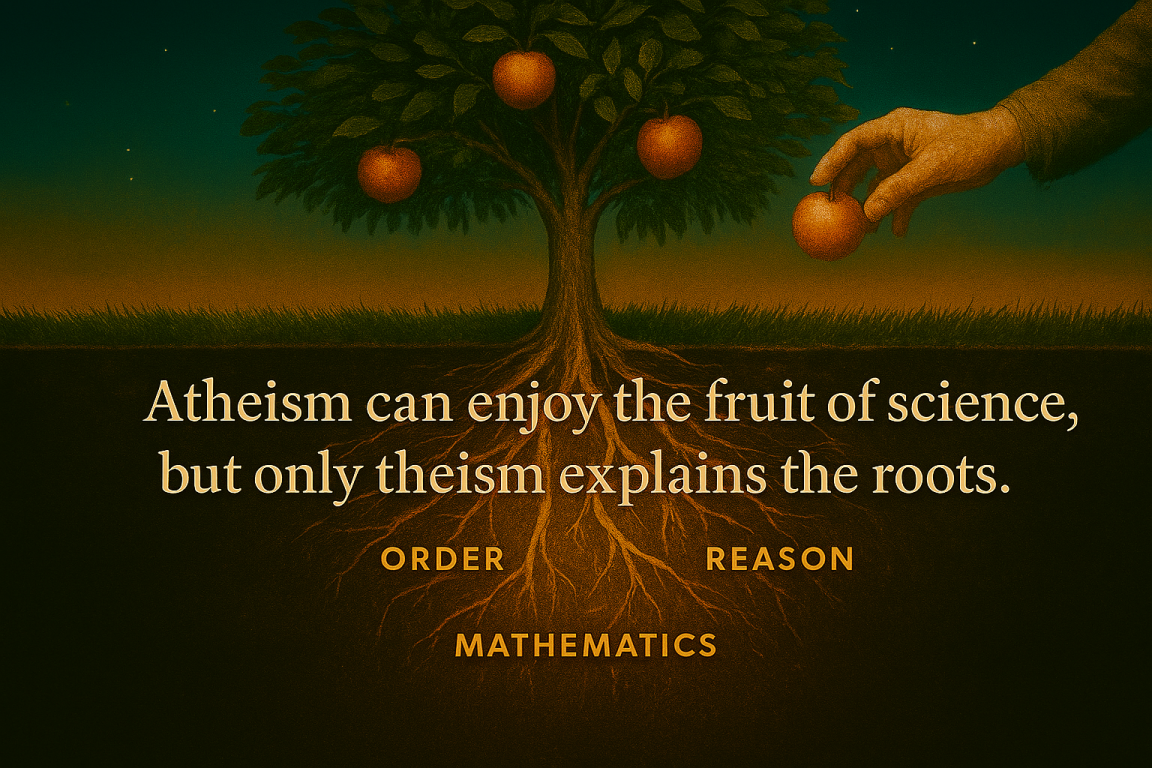
Science is a tree whose roots sink deep into realities we often take for granted: order, reason, mathematics, and moral values. These roots are not optional—they are the very conditions that make science possible. Theism nourishes those roots, offering a coherent explanation for why they exist at all.
Atheism, by contrast, eats the fruit but denies the soil. It enjoys the discoveries, the theories, the dazzling achievements of science, yet it cannot explain why the tree grows in the first place. It borrows the assumptions but refuses to acknowledge their source. The tree still bears fruit, but the denial of its roots rings hollow.
⚖️ Science as Courtroom Witness
Science is also a witness in the courtroom of ideas. It testifies to order, reason, mathematics, and values. Theism can cross-examine and provide coherence. Atheism cross-examines but cannot account for the testimony. The verdict is clear: science leans toward theism.
🚀 The Provocation and Reflection
Here is the provocation: atheism can enjoy the fruit of science, but only theism explains the roots. Until atheism can explain how the tree grows without soil and how the witness speaks without coherence, its claim to science remains hollow.
And perhaps the real question is not whether science disproves God, but whether we’ve asked science to do a job it was never designed for. Its silence may be an invitation—to look deeper, beyond the frame, into the roots that nourish not only knowledge, but our search for meaning.